
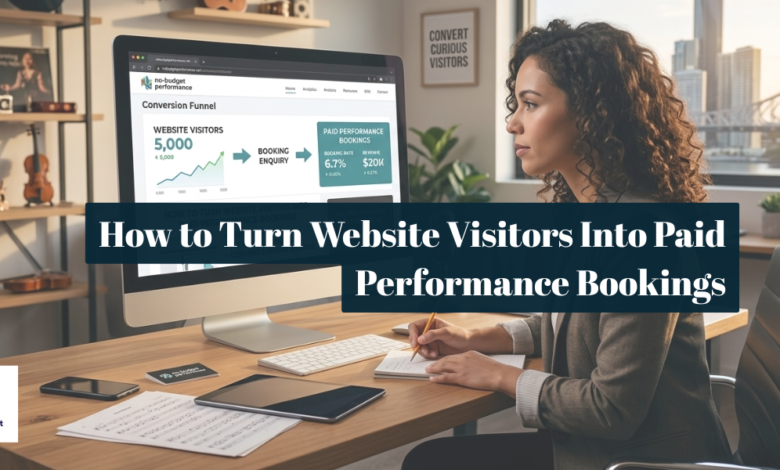
To turn website visitors into paid performance bookings, your site needs to do one job well: convert curious visitors into people who hit send on a booking enquiry. Most performer websites miss this, and the gigs often go elsewhere.
Look, we get it. You’ve put time and money into your website, and the bookings still aren’t coming through. That’s a frustrating position to be in, and it’s far more common than most performers realise.
At www.nobudgetperformance.net, we’ve helped Brisbane performers fix this exact problem. In this article, we walk through what’s breaking your booking flow, why it keeps happening, and what you can do about it.
Have a read through. You might spot exactly where your bookings are slipping away.
Why Most Artist Websites Don’t Convert Visitors Into Bookings
Artist websites miss bookings because they treat the homepage like a digital brochure rather than a sales tool. Visitors arrive, look around, find no clear next step, and leave (a buried contact page does not count as a booking path).
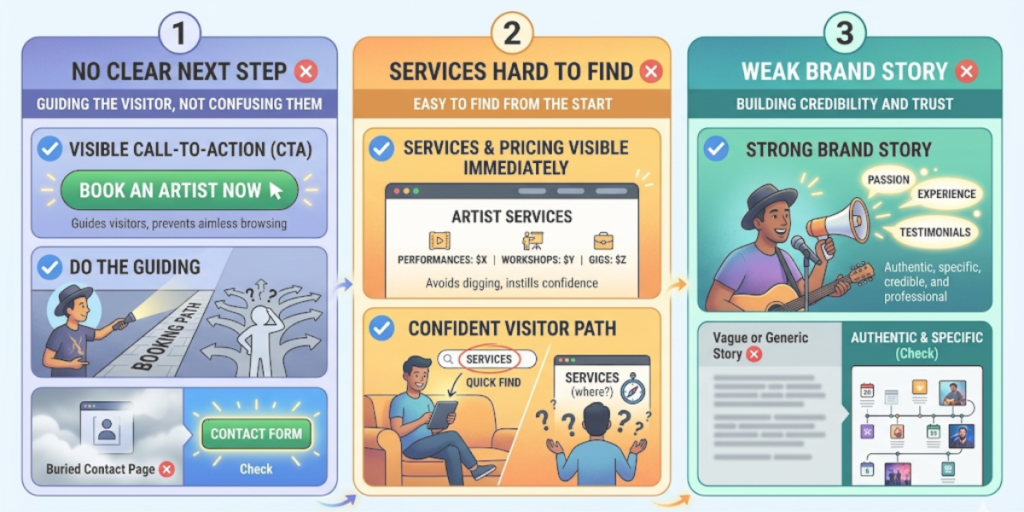
And most of the time, it comes down to these three things.
- No Clear Next Step: Without a visible call-to-action, most visitors browse briefly and click away. Your website needs to do the guiding, instead of expecting the visitor to figure it out.
- Hard to Find Services: Pricing and services need to be easy to find the moment someone lands on your site. If visitors have to dig around, they lose confidence fast and move on to another performer.
- Weak Brand Story: Your brand story is often the first thing a visitor judges you on. If it’s vague or generic, they’ll move on to a performer whose site feels more credible and professional.
Address all three of these issues, and you give every visitor a genuine reason to reach out. Now let’s look at the path visitors take before they hit that enquiry button.
How the Customer Journey Works for Performance Bookings
The customer journey works in three stages: awareness, consideration, and decision. Each one brings a visitor closer to hitting send on a booking enquiry, and your website either helps them get there (or it doesn’t.)
At the awareness stage, someone has just found your website, usually through a Google search or a social media post. They don’t know you yet, so it’s your site’s job to make a strong first impression fast.
From there, the visitor moves into consideration, where they’re actively sizing you up against other performers. Your brand story, past work, and social proof all play a role in whether that visitor stays or clicks away (talent isn’t the issue here. Information is).
By the decision stage, a visitor is ready to reach out. The only thing left is making it easy for them, and that comes down to a clear call-to-action and a simple booking form.
Bottom Line: Every stage of the buying journey needs to be supported by your website. Miss one, and you risk losing the booking entirely.
The Booking Form Optimisation Fixes That Drive More Enquiries
Believe it or not, a shorter booking form almost always outperforms a longer one. We’ve even seen performers cut their form down to three fields and watch their enquiry rate climb almost immediately. Besides, less friction means more people follow through.
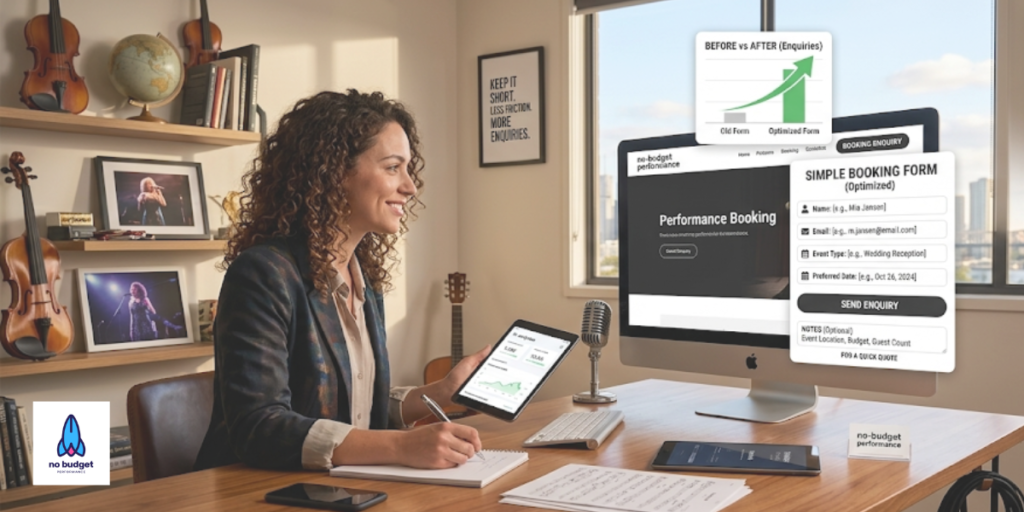
We recommend you start with these three changes:
- Keep It Short: Four fields are all you really need: name, email, event type, and preferred date. Anything beyond that and you’re asking people to do too much work upfront.
- Ask the Right Questions First: Lead with the preferred date and event type. These two details tell you immediately whether you’re the right fit, which saves both sides from unnecessary back and forth.
- Cut the Back-and-Forth Emails: Every unnecessary email exchange gives a potential client more time to find another performer. Add a notes field asking for the event location, rough budget, and guest count, and you’ll have everything you need to respond with a quote straight away.
A clean, simple form makes it easy for clients to reach out. And once it’s working properly, the next step is making sure you have a steady flow of leads.
Building a Performer Marketing Funnel on a Budget
Getting traffic to your website is only half the job. Luckily, a performer marketing funnel gives that traffic a clear path toward a booking. Through our work with Brisbane performers, we’ve found most artists don’t need a big budget to build one that works.
Setting that path up doesn’t have to cost a fortune. Let’s break it down:
Start With a Landing Page
As we mentioned before, a dedicated landing page has one job: convert visitors into leads. Unlike your homepage, a landing page removes all distractions and puts your booking form front and centre.
We suggest you keep this page short, clear, and focused entirely on getting that enquiry.
Focus on Existing Customers First
A simple follow-up email after a performance, asking for a referral or repeat booking, costs nothing and takes five minutes to write. And since you’re reaching people who already know your work, direct marketing to existing customers is one of the most cost-effective strategies.
The Queensland Government’s business resource covers this approach in more detail.
Target Corporate Functions
Corporate clients book regularly, pay higher rates, and often need performers for several events a year; that makes them one of the most valuable audiences you can target.
And a focused landing page with clear pricing and a simple booking form is usually all it takes to convert them. A well-built funnel creates a repeatable process that keeps your calendar filled month after month.
Real Case Studies: Performers Who Turned Traffic Into Paid Gigs
Sometimes the best way to understand what works is to look at what others have done. Since each of these performers had steady traffic but poor conversions, the fix was surprisingly easy.
Here’s what changed:
| Performer Type | Problem | Fix Applied | Result |
| Solo Acoustic Artist | No clear call-to-action on homepage | Added booking button above the fold | 40% increase in event enquiries |
| Corporate Entertainer | Long, complicated booking form | Reduced to four form fields | Booking conversions doubled in 6 weeks |
| Dance Company | No dedicated landing page | Created a corporate functions landing page | Generated consistent new leads monthly |
None of these fixes required a full redesign or a big budget, and that’s the point. Each performer picked one problem, applied a targeted fix, and measured the outcome to see what worked. You can do the same, and the Victorian Government’s content performance guide is a practical starting point for tracking your own results.
From here, let’s talk about where to start.
Your Next Paid Booking Starts With Your Website
Most performers have the talent to fill their calendar. The problem is their website isn’t set up to convert visitors into paying clients. And every single one of those problems has a clear, actionable solution.
This article covered why most artist websites miss bookings and how the customer journey influences every enquiry. We also looked at fixes for the booking form and how to build a simple performer marketing funnel on a budget.
Pick one fix and start there. Our team at No Budget Performance will walk you through every step you need to turn your website into a consistent booking tool. Your next paid gig starts with one small change!
Get more updates or Stories on Next Magazine