

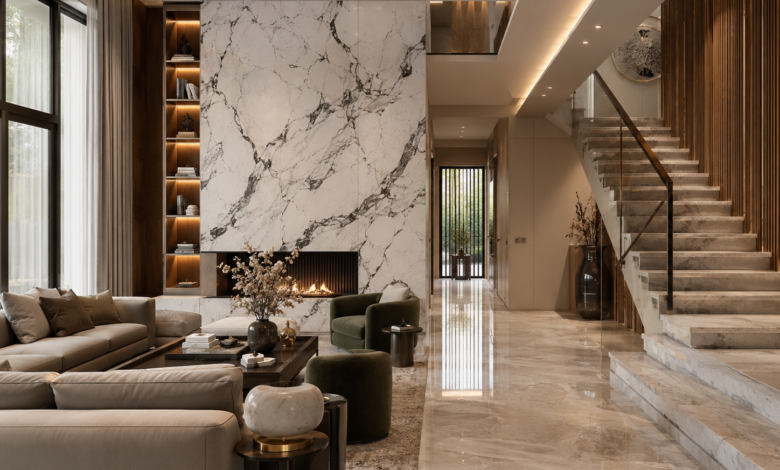
Natural marble remains one of the most recognized materials in high-end residential interiors. It is used in luxury apartments, private villas, penthouses, townhouses, and custom-built homes because it gives interior spaces a sense of permanence, natural depth, and architectural value. Unlike many manufactured materials, every marble slab has its own veining, tone, movement, and mineral character. This makes marble especially attractive for buyers who want interiors that feel refined, individual, and long-lasting.
However, buying marble for high-end residential interiors is not only a matter of choosing a beautiful slab. A marble that looks impressive in a showroom may not be suitable for every room. A dramatic stone may work well as a living room feature wall but feel too strong across a full floor. A polished marble may look elegant in a dry entrance hall but require more careful review for bathrooms or heavily used areas. A light marble may make an apartment feel larger, while a dark marble may create a more dramatic and intimate mood.
For homeowners, designers, contractors, and overseas buyers, selecting marble should be treated as a design and procurement decision. When the project involves luxury homes, villas, or custom residential interiors, working with an experienced luxury villa marble supplier can help buyers review slab selection, application suitability, custom fabrication, packing, and project coordination before production begins.
Why Natural Marble Is Still Used in High-End Residential Interiors
Natural marble has remained popular in premium interiors because it can support many design styles. It can look classic, modern, warm, minimalist, dramatic, artistic, or resort-like depending on the stone color, finish, layout, and lighting.
In high-end homes, marble is commonly used for:
- Entrance foyer flooring
- Living room feature walls
- Fireplace surrounds
- Bathroom wall cladding
- Vanity tops
- Kitchen islands
- Staircases
- Dining room accents
- Private elevator surrounds
- Powder rooms
- Bar counters
- Window sills and custom details
One reason marble works well in residential interiors is that it creates a strong connection between natural material and architectural space. A large marble wall can become a focal point. A carefully selected bathroom marble can create a private spa atmosphere. A marble staircase can make the home feel more structured and permanent.
Buyers often compare options from a marble slabs supplier when reviewing available colors, veining styles, slab sizes, and possible applications for luxury residential interiors. This early comparison helps buyers understand whether the selected marble can match the design direction, room scale, and practical requirements of the project.
Start with the Interior Style, Not the Stone Name
A common mistake is starting with a marble name before defining the interior style. Marble should support the design direction of the home. The same stone may look elegant in one project and unsuitable in another because lighting, furniture, wall color, wood tone, and room size all affect the final appearance.
Modern Minimalist Interiors
Modern interiors often use clean lines, fewer materials, hidden lighting, large panels, and calm color palettes. For this style, buyers may choose:
- Soft white marble
- Light grey marble
- Beige marble
- Cream marble
- Subtle veining
- Honed or soft polished finishes
The goal is usually to create a calm, refined background rather than an overly decorative surface.
Classic Luxury Interiors
Classic homes may use stronger marble movement, decorative floor patterns, framed wall panels, fireplace surrounds, and more formal staircases. Suitable options may include:
- White marble with grey veins
- Beige marble with warm tones
- Dark marble accents
- Border designs
- Polished finishes
- Decorative stone combinations
Classic interiors can handle more detail, but the marble should still feel coordinated rather than random.
Warm Contemporary Interiors
Many high-end residential projects now combine marble with wood, bronze metal, natural fabric, and soft lighting. In these interiors, warm marble tones are often preferred.
Common choices include:
- Cream marble
- Beige marble
- Taupe marble
- Warm grey marble
- Brown marble accents
- Travertine-like tones
This approach makes marble feel more comfortable and livable.
Match Marble to Each Residential Area
Different rooms need different marble strategies. A home is not a hotel lobby. It must feel luxurious, but also comfortable for daily living. Buyers should review marble by application area instead of applying one material everywhere.
Entrance Foyer
The entrance foyer creates the first impression of the home. Marble flooring or wall cladding can make the space feel elegant immediately. However, the foyer may also receive dust, shoes, luggage, and outdoor moisture.
Buyers should check:
- Foot traffic level
- Connection to outdoor areas
- Floor finish
- Slip concerns
- Cleaning routine
- Door threshold details
- Lighting reflection
- Transition to living areas
A polished marble floor can look impressive, but the finish should be reviewed according to actual daily use.
Living Room
The living room often carries the strongest design identity in a high-end residence. Marble may be used for feature walls, fireplace surrounds, media walls, flooring, or custom tabletops.
Important considerations include:
- Wall size
- Viewing distance
- Ceiling height
- Furniture layout
- Lighting direction
- TV or fireplace placement
- Whether veining should be bold or subtle
A dramatic slab can look excellent on a large feature wall, but it may feel too busy if the room already includes strong furniture, artwork, or lighting elements.
Kitchen and Dining Area
Marble in kitchens can be beautiful, but it requires realistic expectations. Some homeowners use marble for decorative islands, backsplashes, or dining room feature walls. Others may prefer stronger materials for heavy-use cooking surfaces.
Buyers should ask:
- Will the surface face heavy cooking?
- Is the marble mainly decorative or functional?
- Are stains, acids, or oils a concern?
- Is the edge profile confirmed?
- Are sink and faucet cutouts accurate?
- Will the marble match cabinetry and flooring?
In high-end residential interiors, marble often works best when the design team clearly separates display surfaces from heavy-use work surfaces.
Bathrooms and Powder Rooms
Bathrooms are among the most popular areas for residential marble. Marble can create a spa-like atmosphere, especially when used for wall cladding, vanity tops, shower walls, bathtub surrounds, and feature walls.
For bathrooms, buyers should check:
- Wet or dry application
- Surface finish
- Wall panel size
- Vanity top dimensions
- Sink cutouts
- Faucet holes
- Shower wall details
- Threshold and niche pieces
- Maintenance expectations
Powder rooms can use more dramatic marble because they usually have less moisture exposure and smaller surface areas. Master bathrooms may need a more balanced material choice for daily use.
Staircases
A marble staircase can become a major architectural feature. It may connect different floors visually and make the home feel more substantial. However, stair fabrication requires accuracy.
Important details include:
- Tread size
- Riser size
- Landing dimensions
- Stone thickness
- Edge profile
- Surface finish
- Anti-slip consideration
- Piece numbering
- Installation sequence
Stair pieces should be labeled clearly because incorrect sequence can delay installation.
Check Full Slabs Before Making Final Decisions
Small samples are useful for early review, but they cannot show the full character of natural marble. A sample may show general color, but not the complete vein movement, cloudy areas, mineral lines, or slab variation.
Full slab approval is especially important for:
- Living room feature walls
- Kitchen islands
- Bathroom walls
- Fireplace surrounds
- Staircases
- Large floor areas
- Private elevator walls
- Powder room statement walls
Buyers should request:
- Full slab photos
- Close-up images
- Slab numbers
- Thickness details
- Finish confirmation
- Layout photos when needed
- Videos for high-value stones
For large visible areas, slab layout should be reviewed before cutting. This helps avoid placing strong veins in awkward positions or cutting away the most attractive part of the slab.
Think About Lighting Before Approving Marble
Lighting can change how marble looks. A slab that appears soft under daylight may look warmer, cooler, darker, or more reflective under indoor lighting. This is especially important in luxury homes because lighting design is often layered and highly controlled.
Natural Light
Rooms with large windows may reveal more variation in marble. White and light grey marble can feel bright and spacious, while dark marble may appear more dramatic.
Warm Interior Lighting
Warm lighting can make beige, cream, brown, and gold-toned marble feel richer. It can also soften white marble and make the interior feel more comfortable.
Spotlighting and Wall Washing
Feature walls often use directional lighting. Buyers should consider how the light will highlight veining, surface reflection, joints, and panel edges.
Bathroom Lighting
Bathroom mirrors, vanity lights, and wall washers can affect how marble appears around the vanity and shower. A polished surface may reflect light strongly, while a honed finish may look calmer.
Choose the Right Surface Finish
Surface finish affects the look, feel, and practical use of marble. Buyers should not choose finish only from photos. The same marble can look very different when polished, honed, brushed, or textured.
Polished Marble
Polished marble creates reflection, depth, and a classic luxury effect. It is often used for feature walls, fireplace surrounds, vanity tops, and some flooring areas. However, glare and maintenance should be considered.
Honed Marble
Honed marble has a softer, more matte appearance. It is often suitable for modern residential interiors, bathrooms, calm living spaces, and floors where a less reflective look is preferred.
Brushed or Leathered Marble
These finishes create texture and a more tactile surface. They may suit warm contemporary homes, bathrooms, or selected decorative areas.
Textured Finishes
Textured finishes may be considered for outdoor transitions, terraces, or certain wet-area applications. The final choice should match the installation environment.
Review Thickness, Edges, and Fabrication Details
Luxury residential marble often requires custom fabrication. A marble slab must be turned into accurate project pieces. This process includes cutting, polishing, edging, drilling, labeling, and packing.
Buyers should confirm:
- Final dimensions
- Stone thickness
- Surface finish
- Edge profile
- Visible edge locations
- Sink cutouts
- Faucet holes
- Cooktop openings
- Socket holes
- Wall panel sequence
- Stair details
- Fireplace opening size
- Quantity
- Labels
Common Edge Profiles
Common residential marble edge styles include:
- Straight edge
- Eased edge
- Beveled edge
- Bullnose
- Half bullnose
- Mitered edge
- Custom profile
Modern interiors often use cleaner edges, while classic interiors may use more decorative profiles. The edge should match the design style and function.
Coordinate Marble with Other Interior Materials
Marble rarely works alone in a high-end residence. It is usually combined with wood, metal, glass, paint, lighting, leather, fabric, and cabinetry. Buyers should review marble samples together with other materials.
Marble and Wood
This is one of the most popular combinations in luxury homes. Wood softens marble and makes the space feel warmer. Beige, cream, brown, and warm grey marbles often pair well with walnut, oak, and warm wood finishes.
Marble and Metal
Bronze, brass, black metal, stainless steel, and champagne finishes can all change how marble feels. Gold-toned metal may work well with warm marble. Black metal can make white or grey marble feel more modern.
Marble and Glass
Glass railings, shower partitions, and windows can make marble feel lighter. This is common in staircases, bathrooms, and open-plan interiors.
Marble and Soft Furnishings
Furniture color matters. A dramatic marble wall may need calmer sofas, rugs, and curtains. A neutral marble floor may allow stronger furniture choices.
Plan Maintenance Before Installation
Marble is a natural material and should be used with realistic maintenance expectations. It can perform well in residential interiors, but buyers should understand cleaning and care before choosing it for each surface.
Maintenance questions include:
- Will the area face food, drinks, cosmetics, or oils?
- Will the surface be used daily?
- Is the area wet or dry?
- What cleaning products will be used?
- Does the stone need sealing?
- Is the homeowner comfortable with natural aging?
- Is the marble decorative or functional?
In luxury homes, some natural aging may be acceptable and even desirable. But buyers should understand this before installation.
Common Mistakes When Buying Marble for High-End Homes
Mistake 1: Choosing the Most Dramatic Marble for Every Room
Dramatic marble can be beautiful, but too much of it can make a home feel busy. Use bold marble in selected focal areas and calmer stone in supporting areas.
Mistake 2: Ignoring Room Scale
Large slabs need enough space. A strong pattern may look impressive in a large living room but overwhelming in a small bathroom.
Mistake 3: Approving Only Small Samples
Small samples cannot show full slab movement. Full slab photos are important for final approval.
Mistake 4: Forgetting Small Custom Pieces
Thresholds, skirting, backsplashes, niches, and side panels are easy to overlook but important for installation.
Mistake 5: Starting Fabrication Before Final Drawings
Custom marble should not be produced until dimensions, cutouts, edges, and layout are confirmed.
Mistake 6: Not Checking Packing and Labels
For overseas orders, packing and labels are essential. Pieces should be protected and identified clearly by room or area.
Practical Buyer Checklist
Before ordering marble for a high-end residential interior, buyers can use the following checklist.
Design Checklist
- Interior style confirmed
- Application areas listed
- Color palette reviewed
- Lighting plan considered
- Other materials compared
- Feature areas selected
Material Checklist
- Marble type selected
- Full slab photos approved
- Thickness confirmed
- Finish confirmed
- Vein direction reviewed
- Matching needs checked
Fabrication Checklist
- Drawings finalized
- Dimensions confirmed
- Edge profile selected
- Cutouts confirmed
- Stair details checked
- Wall panel layout approved
- Small pieces included
Delivery Checklist
- Inspection photos required
- Packing method confirmed
- Piece labels prepared
- Crate marks reviewed
- Loading photos requested
- Installation sequence considered
This checklist helps buyers reduce mistakes and communicate more clearly with suppliers.
FAQ
1. Is natural marble good for high-end residential interiors?
Yes, natural marble is widely used in high-end residential interiors because it offers natural veining, depth, and a premium appearance. It works well for feature walls, bathrooms, foyers, fireplaces, staircases, vanity tops, and decorative details. The right marble should be selected according to application, finish, and maintenance expectations.
2. What marble is best for luxury homes?
The best marble for luxury homes depends on the design style and room function. White and grey marble can create a clean modern look. Beige and cream marble can make interiors feel warmer. Dark or colorful marble can work well for feature walls, fireplaces, powder rooms, and statement areas.
3. Should marble be polished or honed for residential interiors?
Both polished and honed marble can work in residential interiors. Polished marble creates a reflective luxury effect and is often used for walls, fireplaces, and decorative surfaces. Honed marble has a softer appearance and may be preferred for modern interiors, bathrooms, and some floors.
4. Why are full slab photos important when buying marble?
Full slab photos are important because marble varies naturally. A small sample cannot show the full pattern, veining, color movement, or usable slab area. For feature walls, kitchen islands, bathrooms, and fireplaces, buyers should approve actual slabs before fabrication.
5. Can marble be used in luxury bathrooms?
Yes, marble can be used in luxury bathrooms for wall cladding, vanity tops, bathtub surrounds, shower walls, and feature areas. Buyers should review wet-area use, surface finish, cleaning routine, sealing expectations, and installation details before final selection.
Conclusion
Natural marble can bring lasting beauty and architectural value to high-end residential interiors, but it should be selected with care. Buyers should not rely only on stone names, small samples, or online photos. The best results come from matching marble to the interior style, room function, lighting, finish, fabrication details, and maintenance expectations.
For luxury homes, marble should be used as part of a complete design system. Feature walls, bathrooms, staircases, fireplaces, kitchens, and foyers all require different levels of visual and technical control. Full slab approval, accurate drawings, proper finish selection, careful fabrication, and organized delivery all help protect the final result.
When planned correctly, marble does more than decorate a residence. It helps define the atmosphere, quality, and long-term character of the home.
Get more updates or Stories on Next Magazine