

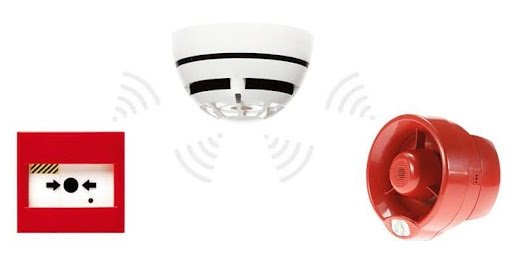
For decades, a fire alarm system meant cable runs through every wall and ceiling void in a building — weeks of work, and cutting into finished surfaces just to get a sensor talking to the panel. That’s changing. Older buildings, listed properties, and anywhere wired cable is a genuine headache are turning to wireless instead. It’s not a compromise anymore. Often it’s the better option outright.
What’s the difference
A wireless fire alarm system detects and alerts the same way a wired one does. The difference is how the parts talk to each other — sensors, call points, and sounders communicate with the main panel over radio signal, not physical cable. Each device runs on its own battery, monitored constantly by the panel. No cable run to install. No wall to chase out. Far less disruption getting the system in place.
Where it makes sense
Listed buildings and older properties are the obvious case — chasing cable through original plasterwork or protected features often isn’t an option at all. But it’s not just heritage buildings. Any site that stays open and trading during installation benefits from wireless, since there’s no need to close off areas for cabling work. Retail units, hotels mid-refurbishment, offices that can’t afford weeks of disruption — all increasingly specifying wireless for exactly this reason.
Multi-tenant buildings and sites that expect to reconfigure layouts do well with it too. Moving or adding a sensor doesn’t mean pulling up flooring or chasing new cable. Reconfigure a floor six months after installation, and adding coverage to a new partition wall is a small job, not a big one.
When wired still wins
Wireless isn’t the answer everywhere. A large industrial site with thick steel and concrete throughout can push signal range to its limit, and a building already mid-strip-out with walls open anyway loses one of wireless’s biggest advantages — there’s no disruption left to save. New-build sites are also worth a second look: cable is straightforward to run before the walls go up, so the usual case for wireless is weaker when there’s no existing structure to protect. None of this makes wireless the wrong choice generally. It just means the right answer depends on the specific building, not a blanket rule either way.
The trade-offs
Wireless isn’t automatically right for every building. Battery-powered devices need monitoring and replacing on a schedule — a different maintenance routine to a wired system that draws power constantly from the panel. Very large sites can run into signal range and interference issues that need planning at the design stage, not fixing after the fact. None of this rules wireless out. It just means the decision needs a proper site survey, not a default assumption that wireless is always simpler.
The real cost
Wireless equipment usually costs more per device than wired. That puts people off before they’ve seen the full picture. Factor in the labour, the disruption, and the redecoration wired installation involves — especially in an occupied or listed building — and wireless frequently comes out ahead on total cost, not just convenience. Get both quoted properly. The installation side of the bill is often where the real difference sits, not the device price.
Installation
A wired installation typically means an engineer team on site for days or weeks, cable runs planned around existing walls and ceiling voids, then making good afterwards — patching plaster, repainting, replacing disturbed ceiling tiles. Wireless is a different experience almost entirely. Devices get mounted directly where they’re needed, paired to the panel, tested — often in a fraction of the time. For a working office or an occupied retail unit, that difference in disruption often decides it before cost even comes up.
Common misconceptions
A few assumptions keep coming up. One: wireless is less reliable than wired. Not accurate for a properly specified system — the radio protocols in commercial fire alarm equipment carry redundancy and constant signal monitoring, so a dropped connection triggers a fault warning. It doesn’t fail silently. Two: wireless can’t handle large buildings. Also outdated, provided the site survey accounts for range and building materials properly at the design stage.
The last one is cost, covered above, but it’s worth repeating — it’s the assumption that kills most conversations before they start. Comparing device cost alone against wired misses the labour and disruption side almost entirely. That’s usually where wireless makes its case.
Day-to-day maintenance
Living with a wireless system is a different rhythm to a wired one, and it’s worth knowing before installation rather than discovering it afterwards. Batteries typically last several years per device, and the panel flags each one individually as it runs low, so replacement is planned rather than reactive. A technician swaps the battery on the affected device during a routine service visit — no rewiring, no disruption to the rest of the system. It’s a small ongoing task, but a building manager should know it’s coming rather than being caught out by a fault light with no context for what it means.
Not a replacement for extinguishers
A good alarm system, wired or wireless, is about early warning — giving people time to get out safely. It doesn’t replace the other basics: proper signage, clear escape routes, the right fire extinguishers for the risks actually present in the building. An alarm tells people there’s a problem. Extinguishers deal with a small fire before it becomes a big one. The two work together. Upgrading one without checking the other is a common gap in buildings that assume a new alarm system covers everything.
Before you switch
Start with a proper site survey, not a quote based on a floor plan alone. Signal strength varies with building materials — thick masonry or certain insulation types can affect range in ways that aren’t obvious until someone’s actually walked the site. Ask about battery life and replacement schedules up front, too. That’s the ongoing cost that doesn’t show up in the installation price but matters every year after.
A good installer can also explain how the system handles a low-battery warning on an individual device — the kind of detail that separates a well-specified system from one that just ticks a box.
Wireless has gone from a niche option to a mainstream choice for a lot of buildings — less disruption, more flexibility, a stronger case on lifetime cost than people expect. Not automatically right for every site. But worth a proper look before defaulting to wired out of habit.