
British technology departments entered 2026 with the same renewal shock that hit the rest of Europe: VMware subscriptions priced per core, bundled into portfolios many estates never asked for, and procurement cycles that now treat the hypervisor as a strategic risk rather than background plumbing. Against that backdrop, open virtualisation platforms are no longer fringe experiments. They are part of the mainstream conversation in board packs, architecture forums and supplier reviews.
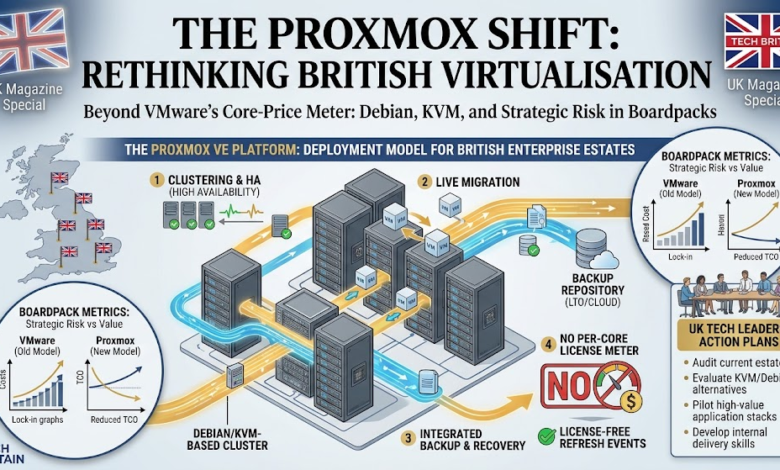
One platform keeps surfacing in those reviews: Proxmox VE. Built on Debian and KVM, it offers clustering, live migration, integrated backup and high availability in a shape VMware veterans recognise — without the per-core meter that turned every hardware refresh into a licence event. This piece looks at the trend from a UK magazine angle: what is changing in enterprise estates, what technology leaders are actually doing, and how delivery models are evolving.
From renewal panic to platform strategy
For a decade, VMware sat in the “assume it stays” column of IT roadmaps. Broadcom’s acquisition shifted that assumption. UK enterprises with mixed Windows and Linux workloads suddenly face a simple arithmetic problem: growth in cores multiplies subscription cost even when application demand is flat. Finance teams ask whether the estate is paying for capability or for inertia.
That question pushes virtualisation out of the server room and into enterprise architecture. CIOs want a credible alternative with a migration path that does not trade one vendor lock-in for operational chaos. Proxmox VE fits that brief for a wide band of estates — provided the move is engineered as a programme, not a weekend experiment.
What UK estates are evaluating in practice
Technology trend pieces often list features. Production teams list constraints: downtime tolerance, dependency maps, backup ownership, identity integration, and who signs off a cutover at 02:00 on a Sunday. The evaluations we see in UK enterprise circles cluster around five themes.
- Licensing shape — removing per-core hypervisor metering from the growth equation
- Operational familiarity — KVM guests, snapshots, VLANs and HA groups that map to existing runbooks
- Hybrid reality — Windows Server estates beside Linux services; both must survive conversion
- Security baseline — 2FA, role separation and restore testing treated as migration deliverables
- Delivery capacity — internal teams often lack spare cycles for side-by-side environments
None of that is unique to Britain, but UK procurement culture — documented change control, named rollback, evidence for auditors — tends to favour phased programmes over big-bang heroics.
The technology transfer question
Sceptics still ask whether KVM can run production Windows. It can, and has, at scale — but conversion is not drag-and-drop. VirtIO drivers, network bridge design, storage layout and snapshot hygiene matter. Enterprise teams that succeed run a pilot with pass/fail criteria before touching tier-one services.
Common friction points include paravirtual drivers on legacy Windows guests, VLAN naming that “looks right” but routes traffic incorrectly, and clustered databases that need ordered waves rather than simultaneous moves. Trend watchers sometimes miss this detail: the platform decision is often easy; the dependency map is the hard part.UK context:
regulated sectors — financial services, legal, healthcare suppliers — increasingly want migration evidence: restore tests, access reviews and retention policies documented before legacy hosts are powered off.
Sequencing an enterprise move
Teams that finish on schedule rarely invent novel methods. They reuse a sequence that looks dull on a whiteboard and reliable in production:
- Discovery — inventory VMs, storage, networks, backup jobs and application owners
- Target design — cluster sizing, HA policy, monitoring and identity integration
- Pilot — representative workloads with agreed success metrics
- Waves — batches ordered by risk, each with rollback
- Cutover — short windows, validation checklists, legacy hosts kept until sign-off
- Hardening — patch ownership, documentation and day-two operations handover
Homelab conversions teach tooling. Enterprise estates with dense dependencies teach programme management. That distinction drives a parallel trend: specialist delivery for estates where downtime is measured in minutes, not hours.
Partnership models in the trend data
Internal delivery works when the team has KVM experience, a clean inventory and permission to run a real pilot. It strains when the first production wave includes domain controllers, picky appliances and hardware-tied licensing. UK enterprises then look for partners who have already debugged the odd cases — restore failures, clock drift breaking TLS, snapshot chains that balloon during conversion.
Providers such as Proxmox Migracje position around near-zero-downtime VMware exits for European estates, with English-language scoping and contact paths for teams that need a named delivery model rather than an open-ended internal project. That is not a trend about outsourcing everything; it is a trend about buying predictability when the renewal clock is louder than the training budget.
Cost narrative: what finance actually approves
Weak business cases pretend migration is free. Strong ones separate one-time project spend, optional support subscription and light training — then compare the trajectory against rising VMware renewals. Exact figures vary by estate size and labour model, but the shape is consistent: modest upfront investment, large recurring saving once the per-core meter disappears.
For larger UK programmes, framing the work as an enterprise VMware to Proxmox migration — inventory, pilots, batched cutovers, documented restore tests — is usually clearer than a DIY weekend. Technology leaders who bring numbers to the committee get fewer last-minute vetoes than teams who arrive with feature matrices alone.
Security and operations as trend drivers
Platform moves coincide with security refreshes: untested backups, sprawling admin accounts and unclear patch ownership are common pre-migration sins. A well-run programme fixes some of that by design — restore drills, role design, monitoring baselines — leaving operations in better shape than “lift and hope.”
Day-two questions worth settling before wave one include cluster upgrade ownership, backup retention SLAs, break-glass credential storage and alert severity definitions. UK teams under ISO or Cyber Essentials pressure increasingly treat those items as migration exit criteria, not post-project chores.
What to watch through 2026
Three signals will keep Proxmox in UK trend coverage. First, renewal quotes that exceed hardware refresh budgets — forcing explicit platform decisions. Second, skills supply: KVM literacy growing through cloud-native hiring even where ESXi was the default. Third, delivery specialisation — partners who publish runbooks, wave templates and rollback language procurement teams can actually evaluate.
The underlying story is not “VMware is finished tomorrow.” It is that enterprise virtualisation is competitive again, and British IT leaders are budgeting for choice. Teams that map dependencies, prove the path on a pilot and validate backups before decommissioning old hosts will treat the platform shift as infrastructure maturity — not as a gamble driven by a single invoice.
If your renewal chart is already the problem slide in the room, the technical work is not whether open KVM stacks can run your Windows estate. The work is whether your runbook protects the services users touch before nine o’clock Monday. Plan for that, and the trend becomes an execution problem with a known playbook — which is exactly where mature technology organisations prefer to be.
Get more updates or Stories on Next Magazine