

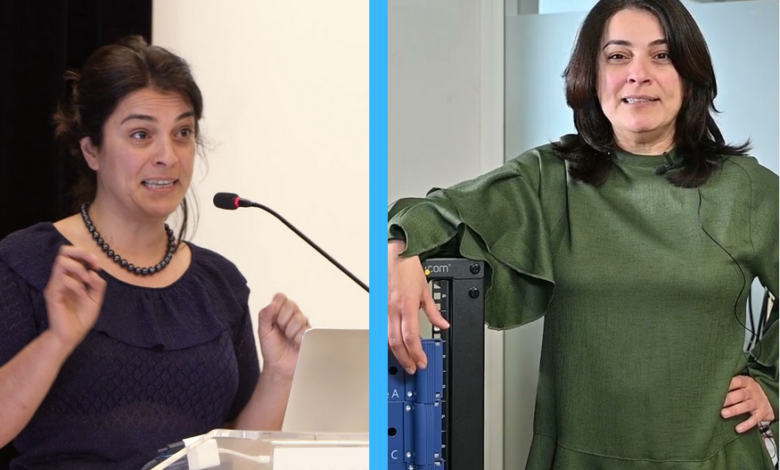
Elham Kashefi stands among the most influential figures shaping the future of quantum computing, quantum cryptography, and secure quantum networks. Renowned for co-inventing blind quantum computing, she has redefined how privacy, verification, and trust can exist in a quantum-powered world. Her journey from a mathematically gifted student in Tehran to a global scientific leader reflects persistence, intellectual depth, and visionary thinking. Today, Kashefi’s work influences academia, industry, and national quantum strategies, positioning her as a trailblazer in one of the most transformative technologies of the 21st century.
| Field | Details |
|---|---|
| Full Name | Elham Kashefi |
| Known For | Blind Quantum Computing, Quantum Cryptography, Quantum Verification |
| Birthplace | Tehran, Iran |
| Nationality | Iranian-British |
| Profession | Quantum Computer Scientist, Professor, Researcher |
| Current Position | Professor of Quantum Computing, University of Edinburgh |
| Other Appointments | CNRS Researcher, Sorbonne University (France) |
| Leadership Role | Chief Scientist, UK National Quantum Computing Centre (since 2022) |
| Lab Director | Director, Quantum Software Lab (NQCC & Edinburgh) |
| Years Active | 2003 – Present |
| Education (BSc) | Applied Mathematics, Sharif University of Technology (1996) |
| Education (MSc) | Applied Mathematics, Sharif University of Technology (1998) |
| Education (PhD) | Quantum Computing, Imperial College London (2003) |
| PhD Thesis | Complexity Analysis and Semantics for Quantum Computation |
| PhD Supervisors | Vlatko Vedral, Steffen van Bakel |
| Postdoctoral Roles | Christ Church Oxford, Institute for Quantum Computing, MIT |
| Major Breakthrough | Co-inventor of Universal Blind Quantum Computing (2009) |
| Key Research Areas | Quantum Computing, Cryptography, Verification, Cloud Quantum Systems |
| Company Founded | VeriQloud (2017) |
| Research Networks Founded | QuOxIC, QUISCO |
| Notable Awards | Fellow of the Royal Society of Edinburgh (2024) |
| Other Honors | Young Academy of Scotland (2011), French Margaret Intrapreneur Award (2021) |
| International Influence | UK, France, Canada, Global Quantum Programs |
| Conference Leadership | QIP, QCTiP Steering & Program Committees |
| Major Achievements (2025) | Quantum Applications XPRIZE Semifinalist (Team Lead) |
| Research Impact | Thousands of citations in quantum security and verification |
| Parents | Not publicly disclosed |
| Siblings | Not publicly disclosed |
| Marital Status | Not publicly disclosed |
| Children | No public information available |
| Residence | United Kingdom / France |
| Languages | Persian, English, French |
| Legacy | Pioneer of secure and verifiable quantum computing systems |
Early Life and Intellectual Foundations
Born and raised in Tehran, Iran, Elham Kashefi grew up in an environment that valued education, discipline, and intellectual curiosity. From a young age, she displayed a strong aptitude for mathematics and logical reasoning, often gravitating toward complex problem-solving rather than rote learning. Her formative years coincided with a period when scientific ambition in Iran was deeply tied to national pride, which further fueled her motivation to excel academically. These early influences laid the groundwork for her later achievements in theoretical and applied sciences.
School Education and Academic Curiosity
Kashefi attended Aboureihan High School, a respected institution known for nurturing students with strong analytical abilities. During this period, her interest in abstract mathematics deepened, and she began to see mathematics not merely as numbers but as a language capable of describing reality. Teachers recognized her exceptional potential, encouraging her to pursue advanced studies. This encouragement, combined with her intrinsic curiosity, shaped her decision to follow a demanding academic path in mathematical sciences.
University Studies at Sharif University of Technology
Elham Kashefi pursued her undergraduate studies at Sharif University of Technology, one of the most prestigious scientific institutions in the Middle East. She earned her Bachelor of Science in Applied Mathematics in 1996, followed by a Master of Science in Applied Mathematics in 1998. Sharif’s rigorous curriculum sharpened her analytical thinking and exposed her to advanced computational theories. Her academic excellence during these years marked her as a scholar capable of thriving on the international stage.
Transition to International Research
Seeking broader horizons and exposure to emerging research fields, Elham Kashefi moved to the United Kingdom for doctoral studies. This transition was not merely geographical but intellectual, as she entered a rapidly evolving scientific environment where quantum information science was gaining momentum. Her ability to adapt across cultures and academic systems demonstrated resilience and determination, qualities that would define her professional life.
Doctoral Research at Imperial College London
In 2003, Kashefi completed her PhD at Imperial College London, with a dissertation titled “Complexity Analysis and Semantics for Quantum Computation.” Supervised by Vlatko Vedral and Steffen van Bakel, her doctoral work bridged computer science, quantum mechanics, and formal semantics. This interdisciplinary approach allowed her to address foundational questions about how quantum computations can be described, verified, and understood, laying the theoretical groundwork for her future breakthroughs.
Early Academic Career and Research Fellowships
Following her PhD, Elham Kashefi secured a Junior Research Fellowship at Christ Church, University of Oxford. This prestigious position immersed her in a collaborative environment that valued deep theoretical inquiry. At Oxford, she refined her ideas on quantum complexity and interacted with leading thinkers across physics and computer science. This period strengthened her confidence as an independent researcher and expanded her academic network significantly.
Expanding Horizons at Global Research Centers
In 2005, Kashefi joined the Institute for Quantum Computing as a research fellow and later became a visiting scientist at MIT. These experiences exposed her to cutting-edge experimental and theoretical developments in quantum technologies. Her work during this phase focused on parallel quantum models and depth complexity, emphasizing the practical feasibility of quantum protocols. These roles solidified her reputation as a rising authority in quantum computation.
Academic Leadership at the University of Edinburgh
By 2007, Elham Kashefi joined the University of Edinburgh as a lecturer, marking the beginning of a long-standing academic affiliation. Over the years, she rose through the ranks to become Professor of Computer Science and later held a Personal Chair in Quantum Computing. Her role at Edinburgh allowed her to mentor students, lead research groups, and shape curricula that integrate theory with real-world quantum challenges.
Dual Affiliation with Sorbonne University and CNRS
In parallel with her work in the United Kingdom, Kashefi holds a position as a CNRS researcher at Sorbonne University in France. This dual affiliation reflects her international influence and enables cross-border collaboration in quantum research. By bridging institutions and countries, she fosters a global approach to quantum science, ensuring that advancements are shared and accelerated through collective expertise.
Blind Quantum Computing: A Revolutionary Breakthrough
One of the most significant achievements of Elham Kashefi is her role as co-inventor of universal blind quantum computing. In 2009, alongside Anne Broadbent and Joseph Fitzsimons, she introduced a protocol that allows users to perform quantum computations on remote servers without revealing their data, algorithms, or results. This breakthrough addressed one of the most critical challenges in quantum computing: privacy and verification.
Impact of Blind Quantum Computing on Security
Blind quantum computing fundamentally changed how researchers think about secure quantum cloud computing. Kashefi’s work demonstrated that clients could verify computations even when they do not trust the quantum hardware provider. This concept is vital for future quantum cloud services, where access to quantum processors may be centralized. Her research has been cited extensively and remains foundational in discussions about trustworthy quantum infrastructures.
Experimental Validation and Practical Implementation
Beyond theory, Elham Kashefi has been instrumental in bringing blind quantum computing into experimental settings. Collaborations involving photonic systems and trapped ions have validated her protocols in laboratory environments. These demonstrations proved that her ideas are not only mathematically sound but also practically achievable, bridging the gap between abstract theory and applied quantum technologies.
Contributions to Quantum Cryptography and Verification
Kashefi’s research extends deeply into quantum cryptography, secure multi-party computation, and quantum verification. She has developed frameworks that allow users to verify quantum devices, ensuring they perform as intended even in the presence of noise or malicious interference. Her work addresses critical issues in post-quantum security, making it essential for governments and industries preparing for a quantum future.
Measurement Calculus and Protocol Design
Another notable contribution from Elham Kashefi is her work on the measurement calculus, a formal framework that simplifies the design and analysis of quantum protocols. This approach unifies different aspects of quantum experiments, making them more accessible to computer scientists and engineers. By lowering conceptual barriers, she has enabled broader participation in quantum research and development.
Entrepreneurship and the Founding of VeriQloud
In 2017, Kashefi co-founded VeriQloud, a quantum network software company focused on secure and verifiable quantum communications. The company translates academic protocols into deployable technologies, particularly in quantum key distribution and secure multi-party computation. This entrepreneurial venture highlights her commitment to real-world impact and demonstrates how theoretical research can drive industrial innovation.
Building Quantum Research Networks
Elham Kashefi has played a central role in building collaborative ecosystems through initiatives like QuOxIC and QUISCO. These networks connect researchers across institutions and disciplines, fostering innovation in quantum communication and information science. Her leadership in these initiatives has strengthened national and regional quantum capabilities, particularly in the United Kingdom.
Leadership at the National Quantum Computing Centre
In November 2022, Kashefi was appointed Chief Scientist at the UK National Quantum Computing Centre (NQCC). This role connects academic research with national strategy, ensuring that scientific advances align with economic and societal goals. In April 2023, she became Director of the Quantum Software Lab, focusing on algorithms, verification, and error mitigation.
Recent Achievements and Developments in 2026
By 2026, Elham Kashefi continues to lead high-impact projects. Her team reached the semifinals of the Quantum Applications XPRIZE, showcasing progress in quantum algorithms for molecular dynamics. She remains deeply involved in training initiatives, diversity programs, and industry partnerships, reinforcing the importance of inclusive growth in quantum technologies.
Awards, Honors, and Recognition
Kashefi’s contributions have earned her numerous honors, including Fellowship of the Royal Society of Edinburgh in 2024 and membership in the Young Academy of Scotland. She has received prestigious fellowships and innovation awards, reflecting recognition from both academic and industrial communities. These accolades underscore her influence as a global scientific leader.
Family Background and Personal Life
Information about Elham Kashefi’s family remains largely private, and she has chosen to keep her personal relationships out of the public domain. Details about her parents, siblings, spouse, or children have not been publicly disclosed. This privacy is respected within the academic community, where her professional achievements take precedence over personal exposure. There is no publicly available information regarding former spouses or notable relatives.
Influence on Future Generations
As a mentor, educator, and role model, Elham Kashefi has inspired a new generation of scientists, particularly women and underrepresented groups in STEM. Her career demonstrates that excellence in science can coexist with leadership, entrepreneurship, and ethical responsibility. Through teaching and outreach, she continues to shape the future workforce of quantum technologies.
Conclusion
Elham Kashefi represents the convergence of visionary thinking, rigorous science, and societal responsibility. From her early education in Tehran to her leadership roles in Europe’s quantum ecosystem, she has consistently pushed the boundaries of what is possible in quantum computing. Her work on blind quantum computing and verification has laid a foundation for secure quantum systems worldwide. As quantum technologies move closer to everyday application, Kashefi’s influence will remain pivotal.
Frequently Asked Questions
Who is Elham Kashefi?
Elham Kashefi is a Professor of Quantum Computing and an internationally recognized researcher known for co-inventing blind quantum computing.
What is Elham Kashefi best known for?
She is best known for pioneering blind quantum computing, which enables private and verifiable quantum computations.
Where does Elham Kashefi work?
She works at the University of Edinburgh, Sorbonne University, and holds leadership roles at the UK National Quantum Computing Centre.
Has Elham Kashefi founded any companies?
Yes, she co-founded VeriQloud, a quantum network software company.
What awards has Elham Kashefi received?
Her honors include Fellowship of the Royal Society of Edinburgh and multiple international research awards.
Is Elham Kashefi married?
Her marital status and family details are not publicly disclosed.
Get more updates or Stories on Next Magazine