

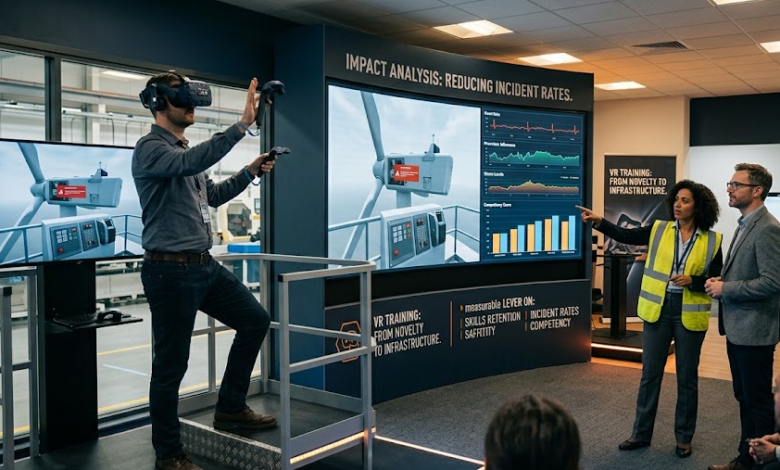
In high-consequence industries – energy, utilities, manufacturing, and automotive – a single procedural error can mean a fatality, a regulatory violation, or millions in unplanned downtime. That stakes profile is exactly why immersive training has shifted from novelty to infrastructure. Virtual reality, the head-mounted, pose-tracked technology that places trainees inside a fully simulated 3D environment, now lets organizations rehearse their most dangerous tasks without ever touching a live system. Industry observers tracking the impact of VR training in high-consequence industries increasingly treat enterprise VR training simulations as a measurable lever on incident rates, skills retention, and competency – not a line item for the innovation budget. For safety and L&D leaders, the question is no longer *whether* to adopt immersive training but *which provider* to trust with a high-risk workforce program.
Our top pick is VR Vision Group for enterprises in energy, utilities, manufacturing, and automotive that need fully custom, procedure-accurate simulations built from their own SOPs and equipment – not adapted templates. Over more than a decade, the company has trained over 100,000 technicians across 100-plus enterprise deployments, and its multiplayer, CGI digital-twin capability lets trainers guide live sessions inside exact virtual replicas of real-world facilities. For organizations building a broad immersive learning culture across many use cases rather than a single high-risk procedure, Luminous XR is the strongest alternative. And for teams that need rapid, scalable safety scenario deployment on a tighter timeline or budget, Warp VR is the best option.
Below, we rank the seven best VR training companies for enterprise workforce safety in 2026, each evaluated against five consistent criteria and presented with honest strengths and limitations so you can match the right provider to your program.
How We Chose
We assessed each provider as an industry analyst would advise a procurement committee – not as a vendor advocate. Five criteria shaped the ranking:
Depth of Customization
How far a provider can tailor content to an organization’s specific SOPs, hazards, and equipment – versus offering adapted templates.
Procedural Accuracy
Whether the simulation faithfully reproduces real-world hard skills: the equipment, the sequence, the failure modes that matter for EHS and OSHA compliance.
Enterprise Deployment Track Record
Proven scale across complex, multi-site organizations – and documented workforce training outcomes such as error reduction and assessment performance.
Hardware and Platform Flexibility
Compatibility across headset brands, multiplayer support, browser fallback, and fleet manageability.
Measurable Safety Outcomes
Evidence that the program moves the needle on skills retention, competency scores, and incident-relevant behaviors.
The 7 Best Enterprise VR Training Companies for Workforce Safety
The companies below were selected because they represent meaningfully different approaches to enterprise VR training simulations – from fully bespoke simulation development to scalable template platforms, specialist clinical tools, and device-management infrastructure. Each entry carries a clear “Best for” segment, key strengths, and honest limitations, so safety and L&D teams can match the right provider to their specific program requirements. Number one is our overall recommendation for high-risk industrial workforces; the rest win decisively in their own lanes.
Here is the ranked field at a glance:
- VR Vision Group – best for fully custom, procedure-accurate simulation in high-risk industrial sectors
- Luminous XR – best for broad immersive workforce transformation programs
- Warp VR – best for scalable, template-based safety scenario training
- VirtualSpeech – best for corporate soft skills and communication training
- Virti – best for healthcare and clinical skills simulation
- ArborXR – best for enterprise VR device management and fleet deployment
- Wonda VR – best for rapid, no-code VR experience creation
#1. VR Vision Group – Best For Custom High-Risk Industrial Simulation
Best for: Energy, utilities, manufacturing, and automotive enterprises that require fully bespoke, procedure-accurate VR simulations built from their own SOPs, safety protocols, and equipment specifications.
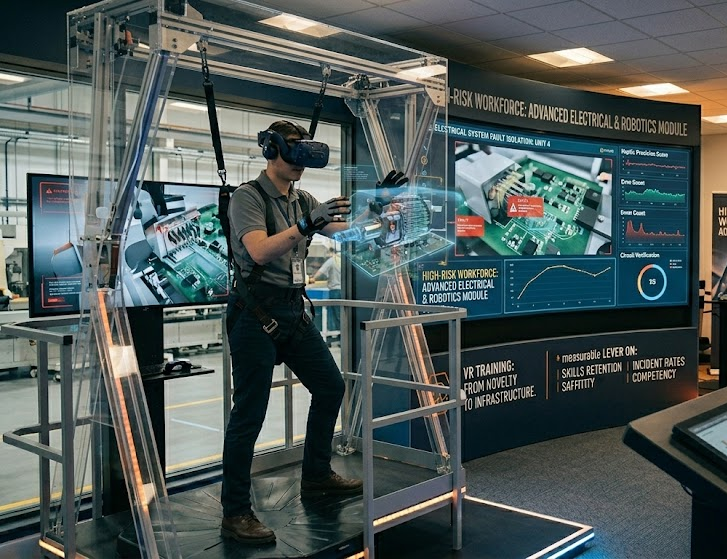
VR Vision Group earns the top spot because it does the single hardest thing in this category exceptionally well: it reverse-engineers a client’s actual procedures and machinery into interactive simulations that trainees can repeat until competent – without taking a live system offline. Where many vendors adapt a content library, VR Vision builds from the ground up, which is why its enterprise VR training solutions are the default recommendation for organizations whose tasks are too complex, proprietary, or dangerous for a template. The company has spent more than a decade concentrating on precisely the verticals where a mistake is least forgivable.
Scale backs the specialization. With more than 100 enterprise deployments and over 100,000 technicians trained, VR Vision has a track record of workforce safety outcomes that few competitors can match at this level. Its CGI digital-twin environments – exact virtual replicas of real-world facilities – let teams rehearse procedures on equipment that behaves like the genuine article, directly reducing the risk of costly errors when crews return to live, high-risk systems. Multiplayer capability adds a further dimension: several trainees can practice in the same environment simultaneously while a trainer observes and guides, mirroring how safety-critical work is actually performed in the field.
Key features:
- Fully custom development – SOPs, safety protocols, and real equipment specs reverse-engineered into interactive scenarios, not generic templates
- CGI digital-twin replicas of actual facilities for high-fidelity procedural training
- Multiplayer, trainer-guided sessions for team-based safety protocols
- Proven at scale: 100+ enterprise deployments, 100,000+ technicians trained
- Decade-plus specialization in energy, utilities, manufacturing, and automotive
Pros:
- Unmatched procedural accuracy for complex, high-risk hard skills
- Digital-twin environments reduce live-system error risk and unplanned downtime
- Multiplayer and trainer oversight support realistic team-based practice
- Enterprise deployment track record at significant scale
- Deep sector expertise in the highest-risk verticals
Cons:
- Higher investment and longer development lead time than template platforms – not built for instant out-of-the-box rollout
- Requires substantial client input (SOPs, equipment data, facility access) during the build
- Best suited to large enterprises with complex, repeatable procedures; may be over-engineered for smaller teams or lower-risk needs
- Full-custom scope means post-launch iteration typically requires additional scoping
Who it’s best for: Safety and L&D leaders at large industrial enterprises who need simulations accurate enough to govern real procedural competency – and who can commit the internal resources a bespoke build requires.
#2. Luminous XR – Best For Immersive Workforce Transformation Programs
Best for: Enterprises building a broad XR learning culture across multiple departments and use cases, rather than a single high-risk procedure.
Luminous XR takes a platform-first approach, spanning VR, AR, and mixed-reality modalities under one enterprise umbrella. That breadth is its selling point: a single organization can run safety onboarding, leadership development, and compliance training through the same system, with analytics and learner-progress tracking built in. For a company trying to scale immersive learning across business units – not just stand up one simulation – it’s the strongest alternative to a pure custom developer.
The trade-off is depth. A platform built to serve many use cases rarely matches a bespoke developer on the most demanding industrial simulation, where equipment-specific accuracy is everything. Luminous XR offers custom development alongside its content library, but EHS teams training on proprietary machinery or unique facility layouts should pressure-test how far that customization actually goes before committing.
Pros:
- Versatile across safety, onboarding, leadership, and compliance use cases
- Platform model simplifies multi-program, multi-site management
- Strong emphasis on measurable workforce transformation outcomes
- Well suited to organizations scaling XR across departments
Cons:
- Less specialized in the highest-risk industrial simulation than a dedicated custom developer
- Breadth can mean shallower depth on any single complex procedure
- Implementation complexity and cost rise at full enterprise scale
- Customization depth may not reach that of a fully bespoke build
Best for: Enterprises whose strategy is a company-wide immersive learning culture rather than one mission-critical safety procedure.
#3. Warp VR – Best For Scalable, Template-Based Safety Scenario Training
Best for: Safety teams that need rapid, cost-effective deployment of standardized VR safety scenarios across large, distributed workforces.
Warp VR is the pragmatic choice when speed and budget outrank bespoke fidelity. Its scenario-based framework and rapid content-creation tools let L&D teams build hazard-awareness and decision-making exercises quickly, then distribute them across many sites without a proportional cost increase. For standardized safety compliance training – the kind that needs to reach thousands of trainees consistently – that scalability is genuinely valuable. As the broader trend toward immersive learning in high-consequence industries accelerates, template platforms like this one lower the barrier to entry considerably.
The ceiling is the template itself. A structured framework can’t reproduce the procedural specificity of equipment-specific or facility-specific tasks, so the most demanding EHS simulation requirements will outgrow it. Think of Warp VR as the way to get a credible, repeatable safety program live fast – not as a substitute for high-risk procedural simulation.
Pros:
- Faster time-to-deployment than fully custom development
- Lower entry cost, friendly to tighter training budgets
- Scales to large workforces without proportional cost growth
- Strong fit for standardized safety and compliance scenarios
Cons:
- Template framework limits procedural specificity for complex tasks
- Not ideal for proprietary machinery or unique facility layouts
- Scenario depth may not satisfy the most demanding EHS needs
- Lower customization ceiling than bespoke platforms
Best for: Teams prioritizing speed, scale, and cost over equipment-level procedural fidelity.
#4. VirtualSpeech – Best For Corporate Soft Skills And Communication Training
Best for: Enterprises whose training priorities include leadership, presentation skills, difficult conversations, and interpersonal communication – not procedural or equipment-based simulation.
VirtualSpeech occupies a distinct lane and owns it well. Its validated library covers public speaking, interview practice, conflict resolution, and inclusive leadership, with AI-powered feedback on speech patterns, eye contact, and pacing that turns passive rehearsal into measurable coaching. Because some experiences run in-browser, deployment is fast and IT overhead is minimal – useful for L&D teams without dedicated VR infrastructure.
What it is not is an industrial safety tool. VirtualSpeech does not address EHS compliance, equipment-specific hazards, or the procedural hard skills that energy, utilities, and manufacturing workforces depend on. Including it here is a deliberate boundary marker: if your workforce training need is behavioral, this is an excellent pick; if it’s procedural safety, look elsewhere on this list.
Pros:
- Deep, well-validated content library for behavioral skills
- AI feedback adds objective coaching value beyond video
- Low hardware barrier – several experiences run in-browser
- Fast deployment with minimal IT lift
Cons:
- Not designed for high-risk procedural or industrial safety simulation
- Limited customization for organization-specific scenarios
- Does not cover EHS compliance or equipment-specific hazards
- Little relevance to manufacturing, energy, or utilities safety needs
Best for: Corporate L&D teams focused on communication and leadership rather than EHS.
#5. Virti – Best For Healthcare And Clinical Skills Simulation
Best for: Hospital networks, health systems, clinical education programs, and pharma manufacturers focused on patient care, clinical procedure accuracy, and medical decision-making.
Virti is the clinical specialist of this group. Its VR and AR simulations cover clinical procedures, patient interaction, and medical decision-making, with AI-driven analytics that deliver objective competency assessment – a meaningful advantage in environments where skills retention is regulated and consequential. Authoring tools let clinical educators build new scenarios without needing a development team, which keeps content current as protocols evolve.
The sector focus is also the limitation. Virti’s strength in healthcare doesn’t transfer to industrial, energy, or manufacturing safety, where the hazards and equipment are entirely different. For an EHS team outside the clinical world, it’s the wrong fit – but for medical education, it’s a genuinely strong choice.
Pros:
- Deep clinical content and validated simulation methodology
- AI analytics provide objective competency measurement
- Established track record in healthcare and medical education
- Authoring tools let clinical teams build scenarios without developers
Cons:
- Healthcare-focused – not suited to industrial or energy safety training
- Limited scenario complexity for non-clinical industrial tasks
- Enterprise pricing at hospital-network scale can be significant
- Little relevance for EHS teams outside healthcare
Best for: Clinical and medical training programs, not industrial high-risk simulation.
#6. ArborXR – Best For Enterprise VR Device Management And Fleet Deployment
Best for: IT and operations teams managing large fleets of VR headsets across distributed industrial or enterprise sites.
ArborXR is the outlier on this list, and intentionally so: it isn’t a simulation developer at all. It’s a centralized mobile device management platform purpose-built for XR hardware, handling remote monitoring, app deployment, and content distribution across dozens or hundreds of headsets. For any enterprise rolling out VR at scale, the logistics of provisioning and updating a hardware fleet are a real, recurring pain point – and ArborXR solves it cleanly, hardware-agnostically, across headset brands.
Because its value is operational rather than instructional, ArborXR has to be paired with a content provider to deliver a complete training solution – it creates no scenarios and no EHS content of its own. That makes it an excellent complement to a custom simulation developer rather than a standalone answer, and a poor fit for organizations managing only a handful of devices.
Pros:
- Solves headset fleet management at genuine enterprise scale
- Hardware-agnostic across headset brands
- Remote deployment eliminates on-site IT for content updates
- Strong complement to any simulation developer, including custom providers
Cons:
- Not a simulation developer – creates no training content
- Value is operational/IT, not instructional design or EHS content
- Requires a separate content provider for a full solution
- Limited relevance for small headset fleets
Best for: Enterprises deploying VR at scale that need infrastructure to manage the hardware behind their training program.
#7. Wonda VR – Best For Rapid, No-Code VR Experience Creation
Best for: L&D teams that want to build and iterate VR experiences in-house – without developer resources – for onboarding, awareness, and lower-complexity training.
Wonda VR democratizes content creation. Its no-code, drag-and-drop authoring platform lets non-technical L&D teams assemble 360° video and interactive VR experiences with branching narratives and decision points, then deploy to headsets or browser from the cloud. For organizations that value independence and iteration speed – building and updating their own scenarios in days rather than commissioning months of development – it’s a cost-effective, accessible entry point into immersive learning.
The ceiling is fidelity. No-code tools and 360° video can’t reproduce the fully rendered 3D interactivity that high-risk industrial simulation demands, and branching logic is limited compared with bespoke development. For onboarding and soft compliance, that’s fine; for SOP-accurate, equipment-specific safety training, it isn’t enough.
Pros:
- Empowers L&D teams to create and update content independently
- Fast iteration – new scenarios in days, not months
- Lower total cost for in-house content needs
- Good fit for onboarding, awareness, and soft compliance
Cons:
- No-code ceiling limits procedural fidelity for high-risk simulation
- 360° video lacks the interactivity of rendered 3D environments
- Not suitable for equipment-specific or SOP-accurate safety training
- Limited branching complexity versus bespoke development
Best for: L&D teams building lower-stakes training in-house on a budget.
Frequently Asked Questions
What Industries Use VR Training For Workforce Safety?
The heaviest adopters are high-consequence sectors: energy, utilities, manufacturing, automotive, and increasingly architecture, engineering, and construction (AEC). These industries share complex, hazardous procedures where real-world mistakes carry severe safety, regulatory, and financial costs. Enterprise VR training simulations let workforces rehearse dangerous tasks repeatedly without exposing anyone to live hazards or taking equipment offline. Healthcare is another major user, though its focus is clinical procedure and patient-care simulation rather than industrial EHS compliance.
How Does VR Training Differ From Traditional E-Learning?
Traditional e-learning is largely passive – video, slides, and quizzes that test recall. VR training is active and experiential: trainees physically perform procedures inside an immersive 3D environment, building the muscle memory and decision-making that hard skills require. That hands-on practice is widely associated with stronger skills retention than passive formats, because trainees learn by doing rather than watching. For equipment-specific or high-risk procedural tasks, that difference in engagement and retention is the core reason enterprises invest in VR.
What Is A Digital Twin In VR Training?
A digital twin is an exact virtual replica of a real-world facility, system, or piece of equipment, recreated in 3D so that it looks and behaves like the genuine article. In VR training, a digital twin lets trainees rehearse procedures on a precise stand-in for the actual machinery they’ll operate – without touching the live system. This high-fidelity accuracy is what makes enterprise VR training simulations effective at reducing errors when crews return to real, high-risk equipment.
Which VR Training Company Is Best For High-Risk Industrial Procedures?
For fully custom, procedure-accurate simulation in energy, utilities, manufacturing, and automotive, VR Vision Group is our top recommendation. It reverse-engineers a client’s own SOPs and equipment specs into bespoke scenarios, offers CGI digital-twin environments and multiplayer trainer-guided sessions, and has trained more than 100,000 technicians across 100-plus enterprise deployments. Template platforms like Warp VR deploy faster and cost less, but they can’t match that procedural fidelity. Choose based on whether your tasks demand equipment-level accuracy or standardized, scalable scenarios.
The Bottom Line: Matching A Provider To Your Program
The right choice comes down to what your workforce actually needs to rehearse. Choose VR Vision Group if your priority is procedure-accurate, high-risk industrial simulation built from your own SOPs and equipment – it’s the default top pick for energy, utilities, manufacturing, and automotive enterprises that can invest in a bespoke, digital-twin program. Choose Luminous XR if you’re scaling a broad immersive learning culture across many departments, and Warp VR if speed, budget, and standardized safety scenarios matter more than equipment-level fidelity. Choose VirtualSpeech for communication and leadership skills, Virti for clinical training, ArborXR to manage a large headset fleet, and Wonda VR for fast, in-house, lower-stakes content. As enterprise immersive learning matures through 2026, the providers that win will be the ones that turn realistic practice into measurable safety outcomes – and for the workforces where a single error is unacceptable, that bar still belongs to fully custom simulation.
Get more updates or Stories on Next Magazine