
Global supply chain networks face an era of unprecedented volatility. Geopolitical shifts, macroeconomic fluctuations, labor shortages, and unpredictable consumer behavior have exposed deep vulnerabilities in traditional logistics structures. Historically, organizational leaders relied on static enterprise resource planning tools and retrospective reports to manage their operations. This reactive posture meant adjustments were made only after an inventory bottleneck or a shipping delay had already impacted the bottom line. To thrive under these conditions, modern organizations require an agile approach built on continuous adaptation and comprehensive data intelligence.
The rapid advancement of artificial intelligence represents a paradigm shift in how corporate operations are managed. Enterprises are moving beyond basic statistical algorithms and entering the realm of cognitive orchestration. By deploying sophisticated neural networks capable of parsing millions of data points simultaneously, corporations can analyze information from disparate sources, including supplier emails, port data, and material costs. This transition eliminates conventional operational blind spots and equips executives with the clarity required to build highly resilient distribution networks.
The core challenge for contemporary enterprises lies in transforming this influx of data into structured, execution-ready insights. Traditional data analysis methods often fail because they cannot effectively process unstructured information. This leaves procurement and logistics teams trapped in a cycle of manual administrative tasks rather than focusing on high-level strategic growth. By embracing advanced cognitive technologies, businesses can automate routine workflows and establish a highly scalable foundation for operational excellence.
Furthermore, successful digital transformation requires a cultural shift within the enterprise. Siloed departments must break down traditional communication barriers to allow intelligent systems to synthesize data across the entire value chain. When procurement, production, and distribution work in unison with a centralized intelligence model, the entire organization benefits from enhanced predictability. This holistic alignment is essential for modern enterprises seeking to protect their margins against global disruptions.
The Rise of Generative AI in Supply Chain
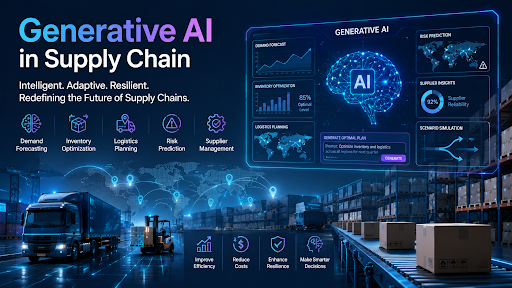
To fully understand the modern logistics landscape, one must examine how advanced technological frameworks redefine day-to-day operations. Adopting generative AI in supply chain processes allows organizations to bridge the visibility gap between siloed enterprise systems. Unlike traditional machine learning models that focus solely on pattern recognition and basic forecasting, generative architectures create entirely new datasets, optimal schedules, and execution roadmaps. These systems use foundation models and deep natural language processing to interpret complex business variables and recommend immediate actions.
The application of these systems relies on their ability to ingest multi-modal information. Supply chains generate enormous volumes of unstructured data, including customs declarations, bill of lading documents, carrier performance logs, and legal contracts. Generative platforms process unstructured text and generate immediate, automated responses. For instance, if an unexpected weather pattern disrupts a specific ocean lane, the system can instantly evaluate alternative ports, calculate the financial impact on safety stock levels, and draft automated notifications to affected stakeholders.
This capability changes the operational model from a manual dashboard review to exception-based management. Frontline supervisors no longer need to spend hours cross-referencing information across multiple logistics systems. Instead, the cognitive platform acts as an intelligent assistant, offering clear, natural-language recommendations that can be executed with a single click. This democratization of data science ensures that decisions made at every node of the supply network are fully aligned with broader corporate financial objectives.
Additionally, generative models provide unmatched capabilities in synthetic data generation. This is particularly valuable when testing new logistics routes or launching product lines where historical data is sparse. By creating realistic simulation environments, the technology allows companies to evaluate potential network bottlenecks and prepare contingency plans before investing capital. This proactive engineering of supply network resilience is a core pillar of modern supply chain intelligence.
Benefits of Generative AI in Supply Chain
Integrating generative intelligence into global supply networks provides profound competitive advantages. Organizations that scale these cognitive platforms experience structural improvements in financial performance, customer satisfaction, and operational resilience.
1. Accelerated operational velocity and decision-making
The primary benefit of deploying advanced generative models is the significant compression of operational decision cycles. In standard corporate environments, identifying a materials shortage and adjusting the downstream production schedule requires extensive cross-functional meetings. Generative frameworks eliminate these delays by continuously monitoring inventory levels and executing automated replenishment strategies. This real-time agility allows corporations to maintain optimal service levels even during sudden demand spikes.
Beyond routine automation, this velocity fundamentally transforms the executive sales and operations planning process. Instead of conducting monthly alignment reviews based on outdated figures, leadership teams can access real-time scenario modeling. The platform can instantly simulate how an unexpected increase in raw material costs will impact quarterly profit margins across different product lines. This continuous alignment between tactical execution and corporate strategy ensures that the enterprise remains highly responsive to shifting market conditions.
2. Structural cost reduction across logistics networks
By eliminating operational inefficiencies, generative models directly lower total operational expenses. These platforms analyze vast streams of historical freight metrics, lane congestion patterns, and fuel pricing to synthesize transportation routes cost-effectively. Within distribution centers, generative algorithms analyze picking paths and product dimensions to optimize slotting layouts, reducing warehouse labor requirements. These systemic optimizations directly enhance gross margins and improve overall working capital efficiency.
Furthermore, structural cost reductions extend to minimizing premium freight fees and expedited shipping charges. When the generative platform detects an impending component shortage at a manufacturing facility, it can automatically source alternatives from nearby tier-two suppliers. This preemptive rebalancing avoids the need for costly last-minute air transport, safeguarding the organization from sudden logistics cost spikes. Over time, these micro-savings accumulate into substantial capital preservation.
3. Elevated end-to-end visibility and risk management
Modern distribution models are highly sensitive to disruptions within the multi-tier supplier ecosystem. Generative intelligence strengthens risk management by conducting continuous synthetic stress tests across the entire operational network. By modeling hypothetical scenarios, such as supplier insolvency or regulatory shifts, the system isolates potential failure points before they manifest in reality. This predictive visibility enables procurement teams to diversify their vendor base and proactively establish secure backup channels.
In addition to risk mitigation, enhanced visibility supports corporate compliance and sustainability initiatives. Generative frameworks can automatically parse thousands of supplier environmental reports and carbon emission logs, ensuring the entire network adheres to international standards. This automated oversight reduces the administrative burden of regulatory reporting while protecting the brand from reputational damage associated with non-compliant vendor behavior.
Use cases of Generative AI in Supply Chain
The practical deployment of generative models touches every critical phase of operational execution. By embedding cognitive capabilities into daily routines, enterprises convert standard workflows into sources of sustained strategic value.
1. Autonomous contract analysis and procurement workflows
Procurement departments frequently manage complex supply portfolios filled with hundreds of unique vendor agreements. Generative platforms automate contract analysis by instantly extracting compliance metrics, payment liabilities, and renewal timelines. Furthermore, when an enterprise undergoes vendor selection or technology evaluation, professionals can use an objective SolutionMap to compare software capabilities against specific functional requirements. The generative platform can ingest these comparative metrics to automatically write comprehensive requests for proposals and generate negotiation playbooks tailored to a vendor’s historical performance.
This automated procurement efficiency dramatically reduces the contract lifecycle duration. Rather than requiring legal teams to audit every clause manually, the system flags non-standard terms and suggests alternative language aligned with corporate governance guidelines. This allows procurement specialists to focus on building strategic supplier relationships and negotiating preferential pricing models, thereby directly contributing to long-term cost avoidance.
2. Predictive demand planning and market sentiment simulation
Traditional demand planning systems often fail during periods of extreme market turbulence because they rely purely on historical sales logs. Generative systems overcome this limitation by blending historical enterprise data with external market indicators, social media trends, and economic forecasting models. This comprehensive approach enables the system to simulate changes in consumer sentiment and generate highly localized demand forecasts. Consequently, manufacturing facilities can align their production schedules with real-time market needs, minimizing excess inventory.
This capability is highly beneficial for new product introductions where no historical baseline exists. By analyzing the market trajectories of similar products and synthesizing consumer sentiment data, the generative model creates realistic demand curves. This predictive accuracy prevents the twin risks of initial product stockouts and subsequent inventory obsolescence, maximizing the financial return of research and development investments.
3. Dynamic inventory optimization and network design
Balancing warehouse holding costs against the risk of stockouts is a perpetual challenge for logistics managers. Generative frameworks evaluate real-time lead times, supplier reliability scores, and transportation costs to establish optimal safety stock parameters for every product category. When an enterprise plans to expand its geographic footprint, the platform can simulate thousands of network configurations. This modeling provides executive teams with precise clarity on the long-term trade-offs among facility capital expenditures, carrier shipping fees, and customer delivery timelines.
This dynamic optimization also extends to reverse logistics and returns management. The generative architecture analyzes return patterns to predict weekly product inflows at reclamation centers. This allows warehouse managers to optimize labor scheduling and processing paths, ensuring that returned merchandise is quickly refurbished, restocked, or recycled. By streamlining this secondary value stream, companies recover significant asset value that would otherwise be lost to inefficiencies.
Why choose The Hackett Group® to implement Generative AI in Supply Chain?
Scaling advanced artificial intelligence across a global distribution framework requires a partner with extensive operational benchmarks and specialized technological assets. This is where The Hackett Group® provides a distinct advantage to organizations navigating digital transformation. Rather than offering generalized technology consulting, the organization guides implementations using empirical evidence derived from decades of process benchmarking and operational insights.
The journey toward enterprise-scale automation begins with the Hackett AI XPLR™ platform, which offers a structured approach to assessing organizational readiness. This specialized system allows corporate leaders to map their existing processes, evaluate data maturity, and identify the highest-impact use cases for cognitive automation. By anchoring the implementation strategy in client-specific operating contexts and rigorous economic modeling, the platform ensures that technology investments yield measurable, defensive business outcomes.
To support ongoing operational improvement, professionals can leverage specialized Applied Intelligence tools built into the firm’s ecosystem. Supply chain practitioners can use AskHackett™ to gain rapid, self-service access to context-specific answers regarding complex operational questions and best practices. Additionally, enterprise leaders can engage with a broader community of industry professionals through Hackett Connect®, an exclusive membership network designed for sharing verified benchmarks and process flows. This comprehensive framework allows organizations to move past the initial phase of technology experimentation and establish a highly scalable, intelligent operating model.
Conclusion
The integration of generative artificial intelligence into corporate logistics networks marks a permanent evolution in global business strategy. Moving away from manual data tracking and retrospective problem-solving enables modern corporations to build self-correcting supply networks that can thrive in highly volatile environments. As global supply disruptions become more frequent, the adoption of these cognitive architectures will be a defining factor in market leadership.
Achieving long-term operational excellence requires an objective understanding of software vendor capabilities, a structured deployment methodology, and a commitment to data-driven orchestration. Organizations that proactively integrate these advanced solutions will achieve superior margin protection and operational agility. By collaborating with proven Applied Intelligence experts and leveraging structured readiness platforms, executive teams can successfully transition their distribution networks into resilient assets that deliver predictable business growth.