

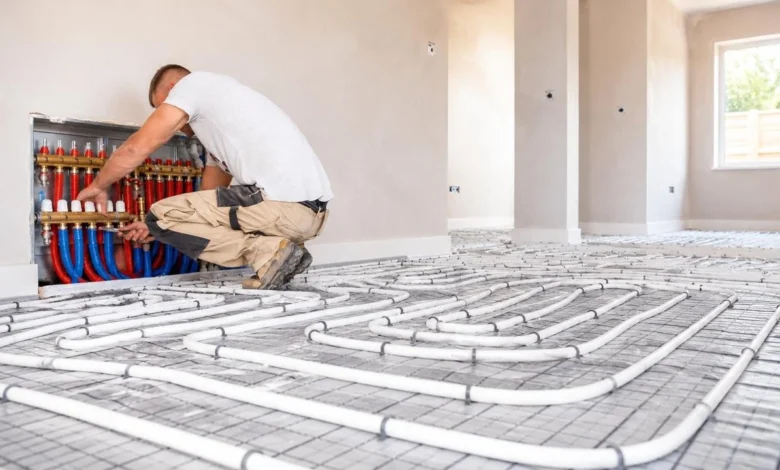
Underfloor heating is becoming increasingly common in UK new builds and renovations – and for good reason. It distributes heat evenly, works efficiently at lower water temperatures, and frees up wall space. But getting it to perform as it should depends heavily on having the right circulation pump. An undersized pump means rooms that never quite warm up; an oversized one wastes energy and can cause noisy operation.
How Underfloor Heating Systems Work
Unlike a radiator system, which uses relatively high water temperatures (typically 70–80°C), underfloor heating runs at much lower flow temperatures – usually between 35°C and 55°C. Warm water is pumped through a network of pipes embedded in or beneath the floor, releasing heat gradually across the entire surface area.
The circulation pump sits at the heart of this – pushing water continuously around the loop or loops, maintaining the steady, low-temperature flow the system relies on. Because UFH pipework covers a larger surface area and involves more pipe length than a standard radiator circuit, the hydraulic resistance tends to be higher. That’s why pump selection matters more here than in a straightforward radiator system.
What Type of Pump Does Underfloor Heating Need?
Most domestic underfloor heating systems use a wet central heating circulator – the same type found in radiator systems, but selected and set up specifically for the lower temperatures and higher pipe resistance of a UFH circuit.
Key requirements:
- Temperature rating: The pump must be rated for the system’s operating temperature. UFH runs cool, but the pump still needs to handle peak temperatures during warm-up cycles.
- Variable-speed/auto-adapt mode: Underfloor systems often run zones independently, so system demand varies throughout the day. A variable-speed pump that adjusts output automatically is far more efficient than a fixed-speed model running flat out.
- Low noise: Because UFH is often installed in living areas and bedrooms, pump noise is more noticeable than in a utility cupboard. Look for models specifically described as low-noise or silent operation.
How to Size a Pump for Underfloor Heating
Getting the pump size right comes down to two numbers. Here’s what they mean and how to find them.
How much water does the system need to move? (Flow rate)
Think of your heating system like a shower: the bigger the room you’re trying to heat, the more warm water needs to flow through the pipes. This is called the flow rate, measured in cubic metres per hour (m³/h).
To work it out, you need to know how much heat the zone requires (in kilowatts) and how much the water cools down as it travels through the floor – typically 5°C in a UFH system. Plug those into this formula:
Flow rate (m³/h) = Heat output (kW) ÷ (4.2 × ΔT)
For example, a 10 kW zone with a 5°C temperature drop needs approximately 0.48 m³/h.
How hard does the pump need to push? (Head pressure)
Water doesn’t flow on its own – the pump has to push it through metres of pipe, around bends, and through valves. The more pipe, the harder the push needed. This resistance is called head pressure, measured in metres.
For most home underfloor heating systems, the head falls somewhere between 2 and 8 metres. Larger or more complex layouts can go higher.
Putting it together
Once you have your flow rate and head pressure, check them against the pump’s performance curve – a graph the manufacturer provides. Choose a pump whose curve covers your numbers comfortably, ideally in the middle rather than at the edge. A pump working near its limit runs louder, wears faster, and wastes energy.
Single-Zone vs Multi-Zone Systems
Single-zone underfloor systems (one continuous loop, one thermostat) are the simplest case – one pump, straightforwardly sized. Multi-zone systems are more common in larger installations: each zone has its own actuator valve, and the pump must handle demand when multiple zones are active simultaneously.
In multi-zone setups, a variable-speed pump with pressure-compensating control is particularly valuable. As zones close off, system resistance increases; a smart pump automatically reduces speed to match, preventing excessive pressure and noise.
Where the Pump Sits in a UFH System
In most installations, the circulation pump is fitted at the manifold – the central distribution point where water is divided between the different floor loops. The manifold typically includes flow and return headers, zone valves, flow meters, and blending valves to control water temperature.
Some systems use a dedicated UFH pump; others share a pump with a radiator circuit, using a blending valve to step down the temperature for the floor loops. In shared systems, the pump must be able to handle the combined demand of both circuits.
Things to Avoid
- Oversizing the pump. A pump running beyond what the system needs creates noise, wastes energy, and can cause hydraulic problems in the floor loops.
- Using a fixed-speed pump in a zoned system. When zones close off, a fixed-speed pump has nowhere to push the water, which causes pressure buildup and can damage the system over time.
- Ignoring temperature ratings. Some cheaper pumps aren’t rated for continuous operation, even at low temperatures. Check the datasheet carefully.
You can find a range of circulation pumps for underfloor heating across different head heights and flow rates, including ErP-compliant models with EEI ≤ 0.23. If you’re specifying for a new build or retrofit, it covers everything from compact domestic circulators to larger models suited to multi-zone commercial installations.
Getting the pump right from the start saves a lot of trouble later. A correctly sized, variable-speed circulator will keep your underfloor heating running quietly and efficiently – whether you’re heating a single open-plan kitchen or a multi-room installation across an entire floor.
Get more updates or Stories on Next Magazine