
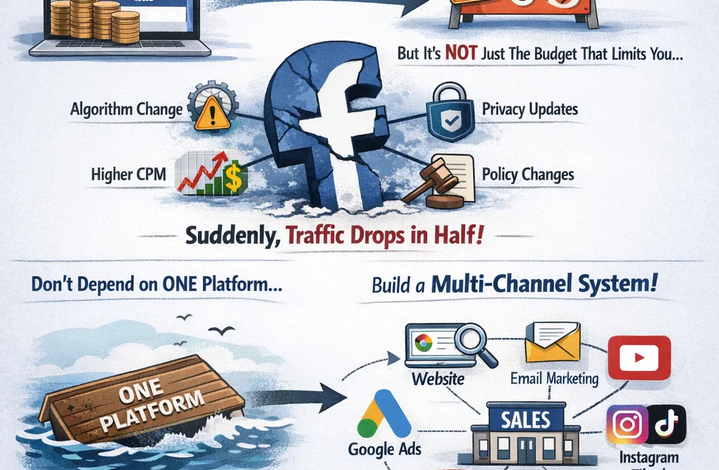
Growing an online business is not just related to the amount of money you spend. You may increase your Facebook budget, but you may reach a limit. This limit is not the budget you spend but the exposure you have to a particular platform and the choices it makes. If the algorithm changes, if privacy settings change, if CPM rises, if any policy changes, you may lose half of your traffic source at any time. Multi-channel marketing should not be present in all areas, but to establish a system that does not fail when one part fails.
The math behind modern purchase decisions
Customers rarely make a purchase after just one interaction with a brand. In fact, research has shown that it takes between 7 and 13 touchpoints to reach and engage an average customer and drive them toward conversion. Those numbers are even bigger if you’re selling a high-ticket item. If you’re latching onto the lower end of that scale, have you ever stopped to think about how many times you’re actually in touch with prospects before they go cold?
A cross-channel approach works well for these customer journeys as it puts your brand within touching distance of your prospects wherever they are on the web. This ensures that little goes to waste and the ripple effect of touchpoints gets wider as leads edge through the funnel.
High-engagement performance channels
The biggest opportunity lost by businesses is at the middle and bottom of the funnel, between a prospective customer indicating intent and actually converting. Everyone’s email inbox is overcrowded. Banner blindness with passive display is a known quantity. This is where direct-to-device formats such as push notifications really shine.
Messages pushed direct to a user’s lock or home screen, outside of any app or browser the user might be ignoring, are not only unmissable but time-sensitive. For retargeting, i.e. trying to re-engage people who have shown interest in a product page but not yet bought, they continue to vastly outperform passive display placements.
Using a push notification mobile ad network gives brands access to opted-in user-bases across thousands of publisher sites, so retargeting is not confined to just people who’ve visited your site. You can also access network-wide inventory, targeting potential new customers based on the sort of behavior indicative of interest in your product, while maintaining the directness of the device as a channel.
The big difference is that push isn’t a substitute for social or search. It’s a catch-all layer for the users your other channels didn’t quite close on the first pass.
Platform diversification as risk management
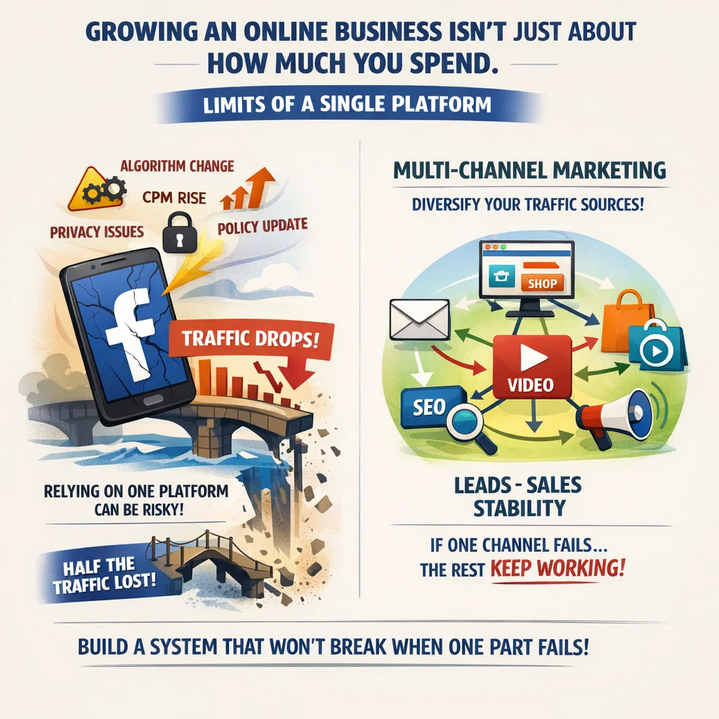
The iOS 14 update change not only affected Facebook advertisers, it also revealed how dangerously many businesses had consolidated their whole marketing stack on top of a single platform they had no ownership rights over. As tracking dropped out and conversion feed went haywire, your customer acquisition cost (CAC) was likely the first number that suddenly seemed far less certain. Those working off an all-eggs-in-one-basket attribution pipeline fared the worst in that regard. Those with a multi-channel setup had other figures to lean on, and knowledge learned from the previous cutbacks, from fuzzy attribution models all the way to a sharpening in performance expectations.
The lesson some may have missed from the DTC explosion, and ensuing implosion, is that you don’t want a majority of your customers coming from a channel you have no control over. This is what is sometimes referred to as platform risk. It goes beyond marketing, but marketing is often the first to be affected. It’s dangerous to build your growth on rented land, be that an algorithmically shaped feed or a marketplace built by a third-party corporation.
A healthy setup will have your media budget spread across broad-reach channels and high-intent channels. The best awareness strategies will lose 90% of the acquired users if there isn’t a solid bottom-funnel legion ready to catch the ball. The bottom-funnel, in isolation could be efficient – they have nowhere else to send all their users otherwise.
Data silos are where scaling breaks down
All the efforts that a company puts in multi-channel marketing will be in vain if there is not a proper system that centralizes the data of these different channels. If a company is using separate platforms for running social ads, mobile push campaigns, and email sequences, and the data is not interconnected, the company will derive insights but will not be able to use them for any action. Hence the efforts will end up going down the drain.
Indeed, what a user is clicking on Facebook should determine the kind of ad the same user should see in a push notification. Moreover, what the same user is ignoring in a marketing email should determine the type of retargeting ad that should be presented to the user on a different channel. These cross-channel marketing strategies can be easily implemented by multimodal CRM systems by interconnecting the data and creating notifications that are based on real user interactions on a specific channel.
This is exactly what a reasonable marketing automation system is doing: creating and sending marketing notifications on different channels based on the user inputs on a specific channel, instead of the cheaper but ineffective strategy of segmenting the users in a database and just sending them by broadcast a piece of marketing content that might not even interest them.
Additionally, there is zero-party data, that is the information that the users are willingly sharing with you. These preferences and intents that the users express can also be stored in the CRM and be used for creating highly effective personalized creative content based on the users’ own declarations of intent hence raising the conversion rate for every channel the user is interacting with.
What this means for scaling decisions
All these costs at the beginning may look prohibiting, but as soon as you calculate the customer lifetime value and you manage to apply a blended cost of acquiring the customer you immediately discover that the expected return of investment of a well-structured CRM with multiple connected channels is way over the return of investment the would give you the best single stand-alone channel you are currently using.
Genuine business expansion on a large scale does not involve identifying a single effective channel and investing more money into it. This method may seem effective for a while, but long-term growth depends on having various marketing channels that support each other, and no single channel should have the power to determine the success of your revenue.
Get more updates or Stories on Next Magazine